
Simmons offer 2 types of simple sink and drainer for fitment to other materials. These can be used to easily and inexpensively create a self-contained wet area of high chemical resistance.
The SD15-DI drop-in sink and drainer unit is designed to be fitted into a rebated cut out in the worktop. The surface should be flush with or set slightly below the worktop so that liquids can be washed into the bowl.
Sinktop size : 860 x 345 mm.
Bowl size : 406 x 305 x 203 mm.
The SD55-DI drop-in sink and drainer unit is designed to be fitted into a rebated cut out in the worktop. The surface should be flush with or set slightly below the worktop so that liquids can be washed into the bowl.
Sinktop size : 1067 x 423 mm.
Bowl size : 635 x 381 x 254 mm.
The SD915-DO drop-on sink and drainer unit is designed to be surface mounted onto a worktop. It includes a raised lip all round to contain spills
Sinktop size : 915 x 415 mm.
Bowl size : 400 x 300 x 200 mm.
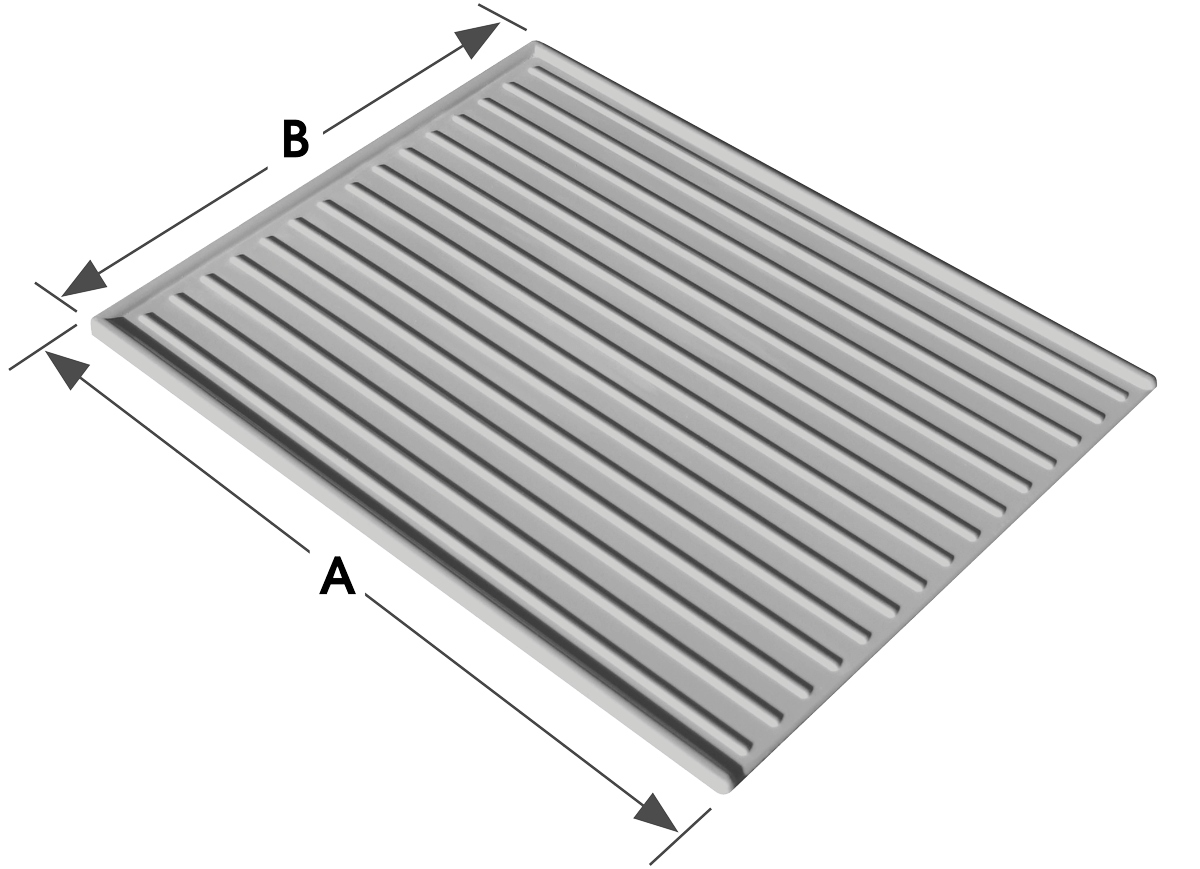
Drainer boards are thin section epoxy resin trays which are sloped to provide drainage to a sink. The surface of the drainer board is ribbed so as to match the profile of the drainers found on all of Simmons’ standard moulded sink and drainer units. Boards are supplied in 2 sizes a
| Size | Length A | Width B |
|---|---|---|
| Medium | 425 | 325 |
| Large | 450 | 400 |
The colours shown on this website are a guide only and cannot be guaranteed to match the colour of components supplied by Simmons.



(24 hour sport test. Based on BS EN 438-2:1991).
Acetone
Unaffected
Acetonitrile
Unaffected
Ammonium Hydroxide – 28%
Unaffected
Aqua regia
Unaffected
Benzyl alcohol
Unaffected
Chloroform
Unaffected
Chloroform – 100%
Unaffected
Chromic acid pickle (*1)
Unaffected
Dicholoromethane
Surface attack
Dimethylformamide
Unaffected
Ethyl acetate
Unaffected
Formaldehyde – 37%
Unaffected
Hydrochloric acid – 30%
Unaffected
Hydrochloric acid – concentrated
Unaffected
Hydrofluoric acid – 40%
Slight bleaching
Hydrogen Peroxide
Unaffected
Methanol
Unaffected
Nitric acid – 70%
Very slight bleaching
Nitric acid – concentrated
Slight yellowing
Nitric acid – fuming
Attack and staining
Perchloric acid – 0.1N
Unaffected
Phosphoric acid – concentrated
Unaffected
Potassium hydroxide pellet (*2)
Unaffected
Sodium hydroxide – 50%
Unaffected
Sodium hydroxide pellet (*2)
Unaffected
Sodium hypochlorite
Unaffected
Sulphuric acid – 70%
Unaffected
Sulphuric acid – concentrated
Surface attack
Xylene
Unaffected
Tensile strength
85 N/mm²
Tensile Modulus
10,500 N/mm²
Elongation at break
0.8%
Flexural strength
112 N/mm²
Flexural Modulus
10,000 N/mm²
Compressive strength
190 N/mm²
Coefficient of linear thermal expansion
34 x 10⁶
Water absorption – 24 hours at 23ºC
5–10 mg (0.06–0.068%) ISO 62 (1980)
Thermal Shock
2000 cycles (90 sec. at 75ºC, 90 sec. dwell, 90 sec. at 15ºC)
No effect
Should not be used with dry-ice or liquid nitrogen
Smoke Emission
Low Smoke Emission – BS 6853 1999 App. D Clause d.8.4
Result – Ao(on) 8.75, Ao(off) 10.41
Flammability
Class 0
Thermal Decomposition
350ºC
Glass transition temperature (Tg)
120 – 130ºC
Decontamination factor (geometric mean)
5598.0
Deviation factor
1.25
Ease of radioactive decontamination classification
"Excellent"
As with all worktops a reasonable standard of laboratory housekeeping will help to keep the worktops in good condition. All spillages should be cleaned up as soon as possible. Staining agents and aggressive chemicals should not be allowed to sit in contact with the tops for a prolonged period of time.
Areas of chemical attack or staining can be removed with a polishing compound or very fine abrasive paper, but it should be stressed that this will alter the finish of the surface. Performance will not be affected.
The use of a wax furniture polish will help to retain the gloss finish.
Components should not be exposed to dry-ice or liquid nitrogen and heat insulation pads should be placed between a top and a steambath or hotplate to prevent thermal stress.