
Simmons’ standard range of sinks are moulded complete with a fixing flange in order to simplify fitment and to optimise the integrity of the joint with the worktop. All sinks are self-supporting on this integral flange. No additional support is required. All sinks are moulded in one piece with a smooth, hardwearing and easy to clean and decontaminate inside surface. They are light and easy to handle.
Drop-in sinks are designed to be easily fitted to any type of worktop material. They can be simply dropped into a rebated cut-out in a worktop. The top face of the flange has a clean surface finish which can be fitted flush with the surface of the worktop. They are particularly suitable for use with laminate worktops as the core material of the laminate is covered by the flange of the epoxy resin sink.
With an undermount fitment (also known as ‘overhang’) sinks are simply bonded and screwed to the underside of the worktop through holes drilled in the flange. If sinks are supplied loose, the flanges can be pre-drilled with fixing holes at additional cost.
Where sinks are factory fitted to Simmons’ own worktops they can be provided undermounted or fitted flush. Flush-fitment involves rebating the sink into the underside of the worktop and then machining the worktop to give a smooth, crevice free joint. This can only be done in the Simmons factory when fitting to a Simmons epoxy worktop.




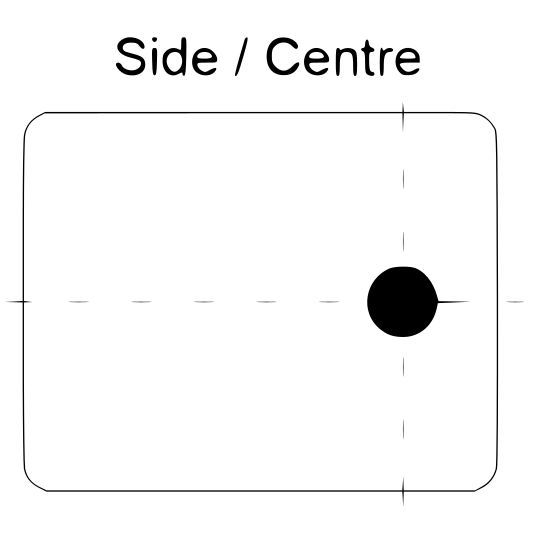
Note:
NOTE: Sinks models not listed above have been retired but may still be available. Please contact us for details.
The colours shown on this website are a guide only and cannot be guaranteed to match the colour of components supplied by Simmons.



(24 hour sport test. Based on BS EN 438-2:1991).
Acetone
Unaffected
Acetonitrile
Unaffected
Ammonium Hydroxide – 28%
Unaffected
Aqua regia
Unaffected
Benzyl alcohol
Unaffected
Chloroform
Unaffected
Chloroform – 100%
Unaffected
Chromic acid pickle (*1)
Unaffected
Dicholoromethane
Surface attack
Dimethylformamide
Unaffected
Ethyl acetate
Unaffected
Formaldehyde – 37%
Unaffected
Hydrochloric acid – 30%
Unaffected
Hydrochloric acid – concentrated
Unaffected
Hydrofluoric acid – 40%
Slight bleaching
Hydrogen Peroxide
Unaffected
Methanol
Unaffected
Nitric acid – 70%
Very slight bleaching
Nitric acid – concentrated
Slight yellowing
Nitric acid – fuming
Attack and staining
Perchloric acid – 0.1N
Unaffected
Phosphoric acid – concentrated
Unaffected
Potassium hydroxide pellet (*2)
Unaffected
Sodium hydroxide – 50%
Unaffected
Sodium hydroxide pellet (*2)
Unaffected
Sodium hypochlorite
Unaffected
Sulphuric acid – 70%
Unaffected
Sulphuric acid – concentrated
Surface attack
Xylene
Unaffected
Tensile strength
85 N/mm²
Tensile Modulus
10,500 N/mm²
Elongation at break
0.8%
Flexural strength
112 N/mm²
Flexural Modulus
10,000 N/mm²
Compressive strength
190 N/mm²
Coefficient of linear thermal expansion
34 x 10⁶
Water absorption – 24 hours at 23ºC
5–10 mg (0.06–0.068%) ISO 62 (1980)
Thermal Shock
2000 cycles (90 sec. at 75ºC, 90 sec. dwell, 90 sec. at 15ºC)
No effect
Should not be used with dry-ice or liquid nitrogen
Smoke Emission
Low Smoke Emission – BS 6853 1999 App. D Clause d.8.4
Result – Ao(on) 8.75, Ao(off) 10.41
Flammability
Class 0
Thermal Decomposition
350ºC
Glass transition temperature (Tg)
120 – 130ºC
Decontamination factor (geometric mean)
5598.0
Deviation factor
1.25
Ease of radioactive decontamination classification
"Excellent"
As with all worktops a reasonable standard of laboratory housekeeping will help to keep the worktops in good condition. All spillages should be cleaned up as soon as possible. Staining agents and aggressive chemicals should not be allowed to sit in contact with the tops for a prolonged period of time.
Areas of chemical attack or staining can be removed with a polishing compound or very fine abrasive paper, but it should be stressed that this will alter the finish of the surface. Performance will not be affected.
The use of a wax furniture polish will help to retain the gloss finish.
Components should not be exposed to dry-ice or liquid nitrogen and heat insulation pads should be placed between a top and a steambath or hotplate to prevent thermal stress.
List of Tools and Equipment required:-
Overhang/Underslung sinks which are supplied loose can be fitted to a worktop with a suitably sized cut out (please ring for recommendation if unsure). Clearance holes for self-tapping screws should be drilled through the sink flange with a masonry drill, and the worktop drilled with a pilot hole to accept same. A layer of silicone sealant should be applied to the flange and the sink should be screwed securely into place. Excess silicone should be removed before it cures.
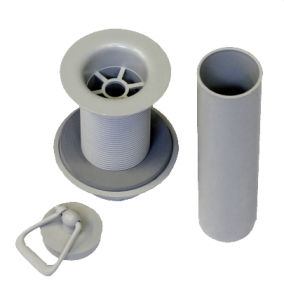 Sinks can be supplied complete with a chemically resistant polypropylene waste in grey, white or black is required. Wastes have a 73mm diameter flange and a 1½ inch BSP tail and will connect to the relevant Vulcathene industrial waste components. These can also be combined with a standing waste tube or an overflow kit.